
In This Article
Unlock the full potential of your credit union's marketing strategy with HubSpot's innovative tools and features.
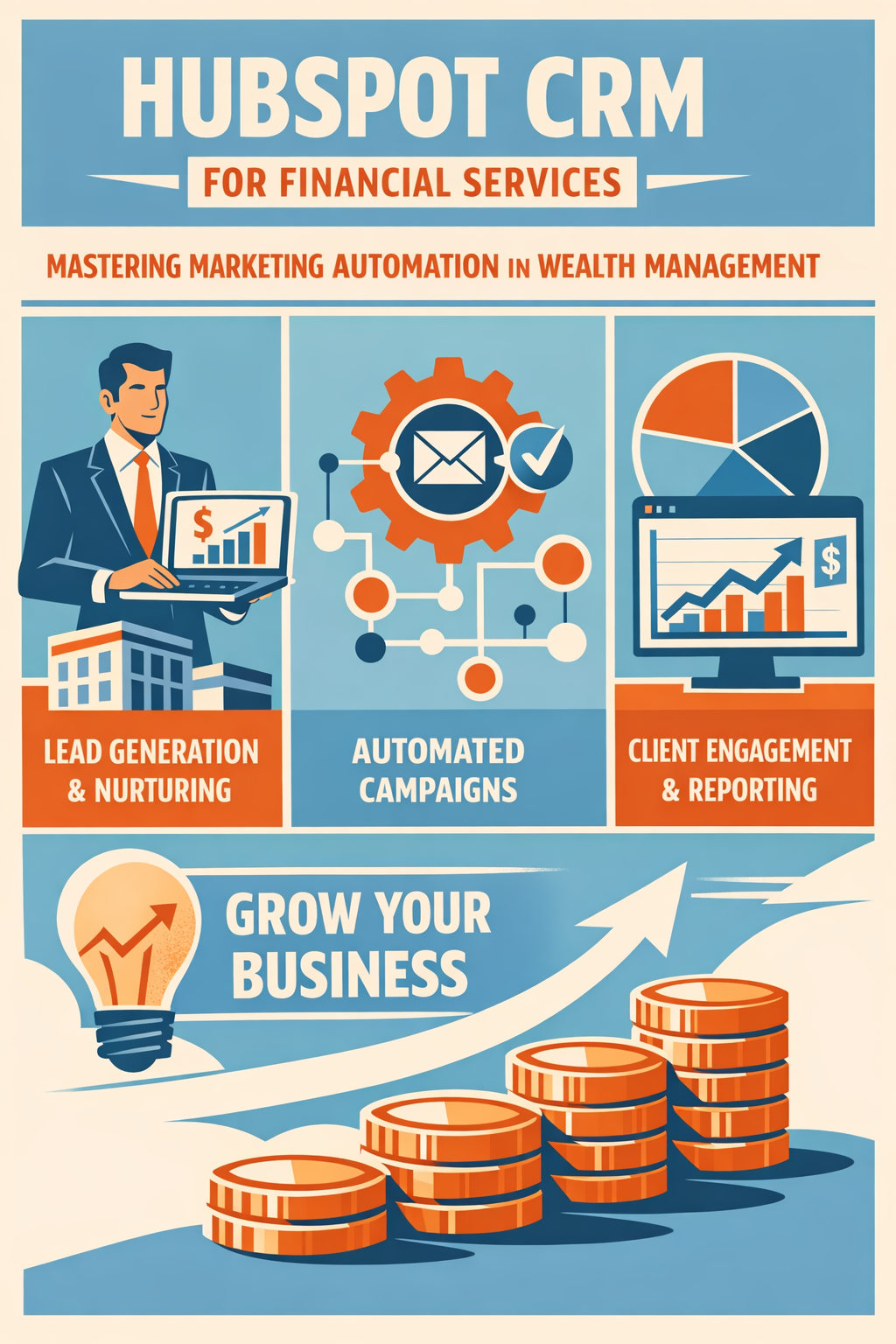
How Financial Advisors Use Marketing Automation to Scale Client Acquisition
While Salesforce Financial Services Cloud dominates enterprise CRM conversations, a different platform has quietly become the marketing engine for growth-focused financial advisory firms: HubSpot.
HubSpot's strength isn't in portfolio tracking or compliance documentation—it's in attracting, engaging, and converting prospects into clients. For financial advisors who understand that sustainable growth requires systematic client acquisition, HubSpot offers capabilities that purpose-built financial services CRMs simply can't match.
The question isn't whether HubSpot can work for financial services—thousands of firms prove that it can. The question is whether HubSpot is the right tool for your specific growth strategy.
Can Financial Advisors Use HubSpot?
Absolutely. Financial advisors across the industry—from solo RIAs to large wealth management firms—use HubSpot successfully. The platform isn't financial-services-specific, but that's actually an advantage for marketing purposes.
Yes, financial advisors can use HubSpot CRM for marketing and client acquisition. HubSpot excels at inbound marketing, email automation, lead nurturing, and content management. Many firms use HubSpot alongside a financial-services-specific CRM like Salesforce Financial Services Cloud or Redtail, with HubSpot handling marketing and the other system managing client service.
The key is understanding what HubSpot does well (marketing, content, lead generation) versus what it doesn't do (portfolio management, financial account tracking, compliance-specific features). Many successful firms run a dual-CRM strategy: HubSpot for prospects and marketing, Salesforce or another platform for clients and service.
The Inbound Marketing Revolution for Financial Advisors
Traditional financial advisor marketing relied on cold calling, purchased leads, seminars, and referral requests. These methods still work, but they're increasingly insufficient for firms seeking scalable growth.
Inbound marketing flips the model. Instead of chasing prospects, you attract them with valuable content that addresses their questions and concerns. When they're ready to engage an advisor, you're already the trusted expert in their mind.
Why Inbound Works for Wealth Management
High-Value, High-Consideration Decisions: Choosing a financial advisor isn't an impulse purchase. Prospects research extensively before committing. Firms that provide helpful, educational content during this research phase build trust and credibility.
Regulatory Tailwinds: The SEC's modernized marketing rule has opened doors for testimonials, reviews, and more authentic marketing. Advisors can now leverage social proof that was previously off-limits.
Digital-First Clients: Even affluent clients begin their advisor search online. Firms invisible in digital channels miss prospects who never knew they existed.
Content Compounds: Unlike advertising that stops working when you stop paying, content marketing builds assets that generate leads indefinitely. A well-written article can attract prospects for years.
HubSpot's Core Marketing Capabilities
Content Management System (CMS)
HubSpot's CMS makes it easy to create and manage a professional website optimized for lead generation:
Blog Platform:
- SEO recommendations built-in
- Mobile-responsive templates
- Social sharing integration
- Analytics and performance tracking
Landing Pages:
- Drag-and-drop builder
- A/B testing capabilities
- Form integration
- Conversion tracking
Pillar Pages and Topic Clusters:
- SEO-optimized content architecture
- Internal linking recommendations
- Search ranking tracking
For advisors without dedicated marketing staff, HubSpot's CMS eliminates the need for web developers while maintaining professional quality.
Email Marketing and Automation
Email remains the highest-ROI marketing channel, and HubSpot provides enterprise-grade email capabilities:
Email Features:
- Professional templates (no design skills required)
- Personalization tokens (name, company, custom fields)
- Send time optimization
- A/B testing
- Detailed analytics (opens, clicks, replies)
Automation Workflows:
- Trigger-based email sequences
- If/then branching logic
- Time delays and scheduling
- Multi-channel coordination
Compliance Considerations:
- Unsubscribe management
- CAN-SPAM compliance
- GDPR data handling
- Suppression list management
Lead Capture and Conversion
Turning website visitors into identifiable leads requires strategic capture mechanisms:
Forms:
- Progressive profiling (ask for more information over time)
- Smart fields (skip fields already known)
- Dependent fields (show/hide based on answers)
- Integration with any page
Pop-ups and Slide-ins:
- Exit-intent triggers
- Scroll-based activation
- Time-delayed display
- Mobile-optimized versions
Live Chat and Chatbots:
- Real-time visitor engagement
- Automated qualification questions
- Meeting booking integration
- After-hours lead capture
Lead Magnets:
- Gated content delivery
- Automated follow-up sequences
- Download tracking and analytics
Lead Scoring and Qualification
Not all leads are created equal. HubSpot's lead scoring helps advisors focus on the most promising prospects:
Scoring Criteria:
- Demographic fit (income, assets, location)
- Behavioral signals (pages viewed, content downloaded)
- Engagement level (email opens, form submissions)
- Timeline indicators (questions asked, meeting requests)
Automation Triggers:
- Route high-scoring leads to advisors immediately
- Nurture lower-scoring leads with educational content
- Re-engage cold leads with targeted campaigns
Analytics and Reporting
Data-driven marketing requires robust analytics:
Traffic Analytics:
- Source attribution (organic, paid, social, referral)
- Page performance
- Conversion paths
- Bounce rates and time on site
Lead Analytics:
- Conversion rates by source
- Lead quality scoring
- Funnel velocity
- Attribution reporting
Revenue Attribution:
- Connect marketing activities to closed business
- Calculate ROI by campaign
- Identify highest-performing channels
HubSpot + Salesforce: The Power Combination
Many financial services firms run HubSpot and Salesforce together, each platform handling what it does best:
The Integration Architecture
HubSpot Handles:
- Website and content management
- Lead capture and initial qualification
- Email marketing and nurture campaigns
- Marketing analytics and attribution
Salesforce Handles:
- Client relationship management
- Financial account tracking
- Service delivery workflows
- Compliance documentation
Data Flow
- Prospect visits website → HubSpot tracks behavior
- Prospect converts → Lead created in HubSpot
- Lead qualifies → Synced to Salesforce as Lead
- Advisor engages → Activity logged in Salesforce
- Lead converts to client → HubSpot updated for attribution
- Client engagement continues → Salesforce manages relationship
This architecture ensures marketing has the tools it needs while operations maintains a system designed for financial services.
Marketing Compliance for Financial Advisors
Financial services marketing operates under regulatory constraints that HubSpot can help manage—but requires careful configuration:
SEC Marketing Rule Compliance
The SEC's modernized marketing rule (effective November 2022) permits:
- Client testimonials and endorsements
- Third-party ratings
- Performance advertising (with guardrails)
- Social proof and case studies
HubSpot can help manage:
- Required disclosures and disclaimers
- Documentation of testimonial consent
- Archive copies of all marketing materials
- Version control and approval workflows
Best Practices for Compliant Marketing
Email: Include required firm disclosures in all marketing emails. Use HubSpot's template system to ensure consistency.
Content: Implement review workflows before publication. HubSpot's approval features can require compliance sign-off.
Testimonials: Document consent and maintain records. Use HubSpot's CRM to track testimonial permissions.
Social Media: Connect social accounts to HubSpot for centralized monitoring and archival.
Breeze AI: HubSpot's Intelligence Layer
HubSpot's Breeze AI brings intelligent automation to financial services marketing:
Breeze Copilot
- Content creation assistance
- Email drafting and optimization
- Blog post outline generation
- Social media caption writing
Breeze Agents
- Automated lead qualification conversations
- Initial prospect engagement
- Meeting scheduling assistance
- FAQ response handling
Breeze Intelligence
- Company and contact enrichment
- Buyer intent signals
- Data quality monitoring
- Duplicate detection
For financial advisors, these AI capabilities accelerate marketing productivity while maintaining the personal touch that wealth management requires.
Building Your HubSpot Marketing Strategy
Phase 1: Foundation (Months 1-2)
- Website migration or optimization
- Blog setup and initial content plan
- Email template creation
- Form and conversion point implementation
- Analytics configuration
Phase 2: Content Engine (Months 3-6)
- Regular blog publication (2-4 posts/month)
- Lead magnet creation (guides, calculators, checklists)
- Email nurture sequence development
- Social media integration
Phase 3: Optimization (Months 6-12)
- A/B testing and refinement
- Lead scoring calibration
- Attribution analysis
- Campaign expansion
- Advanced automation
Phase 4: Scale (Year 2+)
- Paid media integration
- Account-based marketing
- Advanced personalization
- Multi-channel orchestration
Frequently Asked Questions
Can financial advisors use HubSpot?
Yes, thousands of financial advisors use HubSpot for marketing and client acquisition. While HubSpot isn't financial-services-specific, it excels at inbound marketing, email automation, and lead generation. Many firms use HubSpot alongside a financial services CRM like Salesforce, with HubSpot handling marketing and the other system managing client relationships.
Is HubSpot compliant for financial services marketing?
HubSpot provides tools that support compliance—email archival, approval workflows, disclosure management—but compliance ultimately depends on how you use and configure the platform. Financial services firms should work with compliance professionals to establish proper workflows and ensure all marketing meets regulatory requirements.
How much does HubSpot cost for financial advisors?
HubSpot offers a free CRM tier suitable for basic contact management. Marketing Hub pricing starts at $20/month for Starter, $890/month for Professional, and $3,600/month for Enterprise. Most growth-focused financial advisory firms find the Professional tier provides the best balance of capabilities and cost.
Can HubSpot integrate with Salesforce Financial Services Cloud?
Yes, HubSpot offers a robust native integration with Salesforce, including Financial Services Cloud. The integration syncs contacts, companies, deals, and activities bidirectionally. Most wealth management firms using both platforms configure HubSpot as the marketing system and Salesforce as the operational CRM.
What results can financial advisors expect from HubSpot?
Results vary based on content quality, consistency, and market positioning. Well-executed inbound marketing strategies typically see measurable lead generation within 6-12 months. Financial advisory firms report lead-to-client conversion rates of 2-10% for inbound leads, significantly higher than purchased leads or cold outreach.
Making HubSpot Work for Your Firm
HubSpot's power comes from its flexibility—but flexibility requires intentionality. Financial advisory firms succeed with HubSpot when they:
- Commit to content creation as an ongoing discipline
- Integrate with existing systems rather than creating data silos
- Configure for compliance from day one
- Measure what matters with proper attribution
- Think long-term rather than expecting immediate results
Marketing automation isn't a magic solution—it's an amplifier. Firms with compelling value propositions and genuine expertise find HubSpot accelerates their growth. Firms hoping technology will substitute for substance will be disappointed.
Ready to explore how HubSpot can accelerate your firm's growth? At Vantage Point, we help financial services firms design and implement marketing technology strategies that drive sustainable growth. From HubSpot configuration to Salesforce integration to content strategy development, our team brings both technical expertise and industry understanding to every engagement.
Let's discuss your marketing objectives and design a strategy that delivers results.
About Vantage Point
Vantage Point specializes in helping financial institutions design and implement client experience transformation programs using Salesforce Financial Services Cloud. Our team combines deep Salesforce expertise with financial services industry knowledge to deliver measurable improvements in client satisfaction, operational efficiency, and business results.
About Tierney Burklow
Expert consultant at Vantage Point, specializing in CRM implementations and digital transformation for financial services.